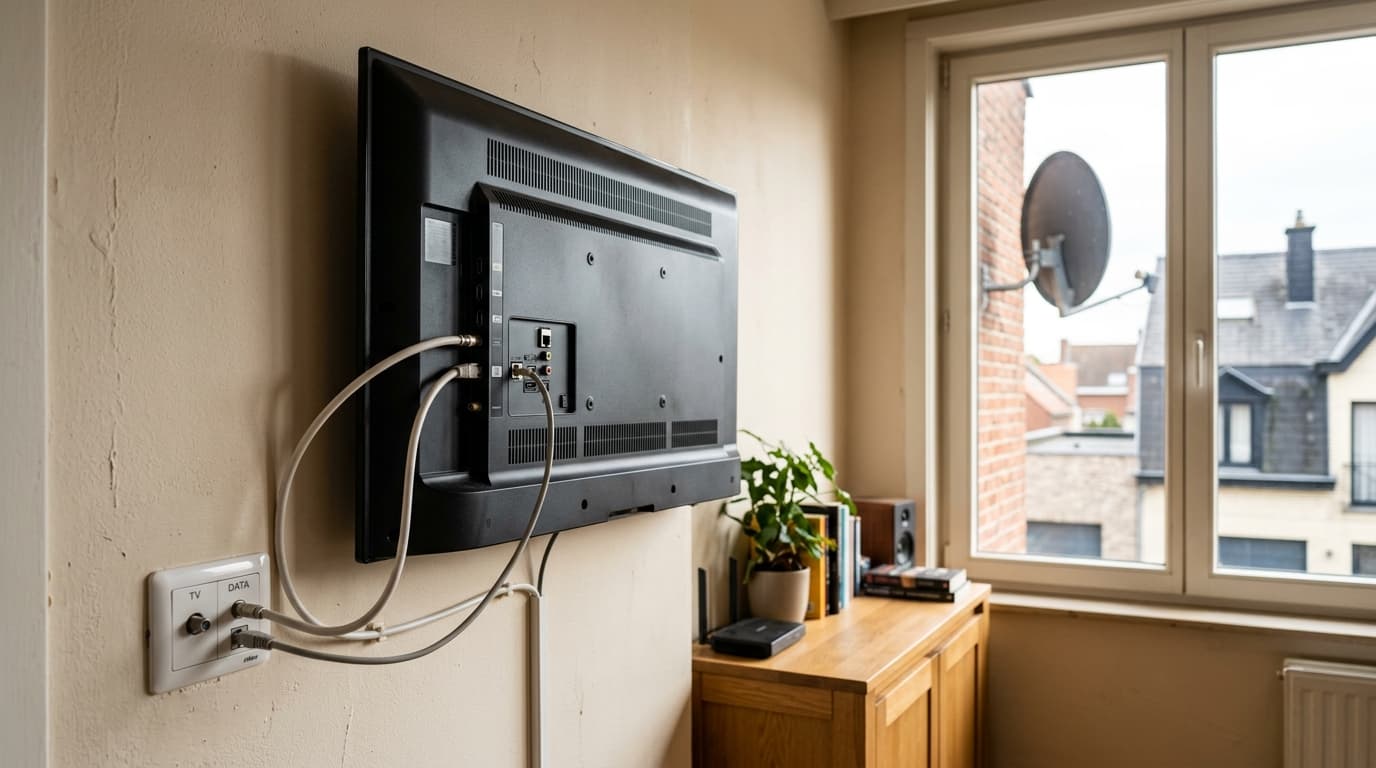
IPTV, cable, satellite and DTT (digital terrestrial television, TNT in French) are four paths television takes into your home: the internet line, the coaxial cable, a dish, a rooftop aerial. In Belgium, the path depends on the operator and the address. And two of those routes are closing: Flemish terrestrial TV went silent in 2024, Telenet's old cable is next.
What is the difference between IPTV, cable, satellite and DTT?
The wire that enters the house, and the box you need at the end of it.
| Mode | How the picture travels | Kit at home | Internet required | Who, in Belgium |
|---|---|---|---|---|
| IPTV | Phone line or fibre, as a stream managed by the operator | Modem, then a box or an app | Yes | Proximus, Scarlet, the new Telenet and Orange boxes |
| Cable (DVB-C) | Coaxial distribution cable | Coaxial socket and a box, or a TV with a DVB-C tuner | No | VOO, older Telenet and Orange boxes |
| Satellite | Dish pointed at the sky | 64 cm dish, a box or a CI+ module | No | Telesat, TV Vlaanderen |
| DTT (DVB-T2) | Terrestrial transmitters | Rooftop aerial, a TV or a DVB-T2 HEVC box | No | RTBF, in Wallonia and Brussels only |
One column decides your bill, the fourth. A reception mode that requires internet sells you two subscriptions. The other three sell you one, or none.
What exactly is IPTV?
Television cut into data packets, like a web page, but on a reserved lane.
The CSA (Conseil supérieur de l'audiovisuel), the audiovisual regulator for French-speaking Belgium, describes it as television over the telephone cable, digital only, and notes that no free offer exists in this form. The difference with Netflix lies in that reserved lane. When your son starts a 60 GB download, Netflix loses sharpness. The operator's IPTV channel keeps its bitrate, because the modem has set part of the line aside for it.
The downside, I measured for seven years at customers' homes around Namur. On a long copper line, television and internet share a bitrate that is already thin, and every box switched on takes a slice of it. A house at the end of a lane in Assesse received enough to feed one television in high definition, not two. Coaxial cable does not have that problem: every channel flows through it permanently, whether one set is on or ten.
Which reception mode does each Belgian operator use?
Proximus and Scarlet are IPTV, VOO is cable, Telenet and Orange are moving from one to the other.
| Operator | Physical network | How TV arrives | Area | Post-promotion price and survey date |
|---|---|---|---|---|
| Proximus | Copper and fibre, its own | IPTV | Nationwide, over 90 % of homes according to the CSA | Flex+ Internet Go + TV: 75.99 EUR/month, surveyed 27/09/2026 |
| Scarlet | Proximus network | IPTV | Same as Proximus | Not surveyed for this article |
| Telenet | Coaxial cable | IPTV on the TV-box, DVB-C on older boxes | Flanders and part of Brussels | Telenet TV: 15 EUR/month on top of internet, surveyed 09/10/2026 |
| Base | Telenet network | App or box | Same as Telenet | Not surveyed for this article |
| VOO | Coaxial cable, bought by Orange | DVB-C with a box | Wallonia and part of Brussels | Duo Net Super Relax TV: 72.00 EUR/month, price list of 01/01/2026 |
| Orange | VOO's cable in the south, Telenet's in the north | IPTV on the 2026 TV Box, coaxial on the older box | Cabled areas | Livebox Up with Orange TV: 82 EUR/month, surveyed 03/10/2026 |
| Telesat | Satellite | Dish | Anywhere with a clear view of the sky | Basic: 22.90 EUR/month, surveyed 09/10/2026 |
| RTBF | Terrestrial transmitters | DTT in DVB-T2 | Wallonia and Brussels | 0 EUR |
This table contradicts the opposition you read everywhere, "cable versus IPTV". It is out of date. Telenet keeps its coaxial cable in the street, but its TV-box receives channels over the internet protocol, and the operator itself writes on the Telenet TV page, surveyed on 9 October 2026, that a Telenet internet subscription is needed to use it. Orange does the same with its TV Box released in summer 2026, whose set-up I cover in the article on the Orange TV box.
The wire is still coaxial. The signal has become IPTV.
Why does Orange run on a competitor's cable?
Because Orange never laid a fixed cable in Belgium, and regulation forced the cable operators to rent theirs out.
The daily L'Avenir summed it up on 4 June 2020: lacking a cable network, Orange rented VOO's infrastructure in Wallonia and Telenet's in Flanders, at wholesale rates set by the Conference of Regulators for electronic communications, on which the BIPT (IBPT in French), the federal telecom regulator, sits. Its chief executive spoke there of more than 200 million euros of negative results on cable in four years. A tenant who loses money ends up buying the building.
That is done for the southern half. The European Commission cleared on 20 March 2023 the acquisition of VOO and Brutélé, the two Walloon and Brussels cable companies, by Orange, on one condition: guaranteeing Telenet access to that network in Wallonia and part of Brussels for at least ten years. So the situation has flipped. In Wallonia, Orange is at home and Telenet can become its tenant. In Flanders, Orange remains Telenet's tenant.
For you, that has one practical consequence. Moving from VOO to Orange changes neither the cable in the wall, nor the socket, nor the speed available at the address. Only the box and the bill change.
Is coaxial cable disappearing?
The wire, no. The DVB-C television that ran through it, yes, and in Flanders first.
Testachats, the Belgian consumer organisation, wrote on 28 September 2026 that cable television will end in Flanders in 2027, with no official date from Telenet at this stage, and that the multi-year plan of the network manager Wyre provides for DVB-C to be removed completely by 2030. Since 1 October 2026, the older Telenet boxes have already lost functions: according to the same source, the guide now shows only two days of programmes and recording is no longer possible.
The sum that stings is the one for a household that only had television. Telenet's Compact TV, 23 channels with no box and no internet, cost 21.93 EUR a month according to Testachats on 3 October 2025. The same operator's entry internet and TV plan is quoted at 76 EUR a month by Testachats on 28 September 2026. The gap is 54.07 EUR a month, or 648.84 EUR a year, to watch the same channels. Telenet is currently giving away six months of TV, a promotion valid from 5 October to 1 November 2026. It does not touch the thirteenth bill.
On the VOO side, nothing has been announced. Testachats notes that no timetable has been published, even as the brand melts into Orange. I would not bet on a ten-year reprieve.
Does terrestrial TV still exist in Belgium?
In the south, barely. In the north, not at all.
RTBF broadcasts La Une, Tipik and La Trois in high definition, plus five radio stations, on a single channel, 42. It moved to the DVB-T2 standard with HEVC coding in summer 2023: switchover on 17 July, with until 31 August to get equipped. An older television limited to DVB-T has shown a blank screen since that date, with nothing actually broken.
In Flanders, VRT, the Dutch-speaking public broadcaster, cut its free signal on 1 December 2018. The paid Antenne TV service, which had taken over, stopped broadcasting on 1 September 2024.
Three public channels, then, for 0 EUR. It is thin, and it is still the only Belgian television with no subscription and no connection. The other free options go through the internet, and I listed them in free live TV in Belgium.
Is satellite TV still worth it?
For a poorly served address or a household that refuses to pay for internet, yes.
On the Telesat website, surveyed on 9 October 2026, the Basic plan shows 61 channels for 22.90 EUR a month post-promotion, excluding activation, equipment and installation fees. Basic Light is 16.90 EUR, Basic+ 32.90 EUR. The Basic list includes La Une, La Trois, RTL tvi, TF1, France 2 and France 3. The equipment pack comprises a 64 cm dish, its receiver head and a box.
The entry costs weigh. Testachats estimated them at about 250 EUR without a promotion on 3 October 2025, which brings the first year of Basic to 524.80 EUR, then 274.80 EUR for the following ones. Two more reservations. The VRT channels are only available there with a box connected to the internet, according to the plan's page. And Testachats noted on the same date that there was no agreement with DAZN, hence no sports package.
Does the reception mode change the channels you get?
Yes, and far more than the price suggests.
The ceiling first: 3 channels over terrestrial TV, 61 advertised in Basic by satellite, more than 80 in a Proximus bundle. Then the line-up. Comparing the official lists on 3 September 2026, I had counted nine French channels included with Orange, on cable, that Proximus puts behind an option or does not carry. The detail is in TF1 in Belgium: which French channels you get.
Technology does not explain everything, though. M6 is carried by no Belgian operator, on IPTV or on cable, because that is a matter of rights. And the 4K promised by a box guarantees nothing: Orange was still writing on 3 October 2026 that it broadcasts no channel in that resolution.
Four checks at the address before signing
- Look at the wall socket. Round with a screw thread, it means coaxial cable, so VOO, Telenet or Orange. A phone socket or an optical unit means Proximus or Scarlet. Both in the same room: you have a choice, and leverage when the time comes to negotiate.
- Ask whether the box needs internet, in those exact words. If the answer is yes, the price to read is the whole bundle, not the TV option.
- Open the television's spec sheet. It lists DVB-C for cable without a box, DVB-T2 HEVC for RTBF terrestrial TV, DVB-S2 for satellite with a CI+ module.
- Demand the channel list at your address, not the number printed on the brochure.
The TV subscription ranking orders bundles on their second-year price, and the comparator filters by operator.
Sources. Conseil supérieur de l'audiovisuel, Repères du numérique, IPTV page (definition, Proximus coverage, illegal use); RTBF, DTT page of 17 July 2023 (channels, DVB-T2, HEVC, channel 42); European Commission, press release of 20 March 2023 on the acquisition of VOO and Brutélé; Testachats, 28 September 2026 (end of cable in Flanders, DVB-C and Wyre, Telenet plans) and 3 October 2025 (Compact TV, TV-box, satellite entry costs, DAZN); L'Avenir, 4 June 2020 (cable wholesale rates); Moustique, 18 February 2026; DVB-C standard; Telenet TV and Telesat pages surveyed on 9 October 2026; VRT and Antenne TV switch-offs according to Selectra, page updated 8 October 2026; post-promotion prices for Proximus surveyed 27 September 2026, Orange 3 October 2026, VOO price list of 1 January 2026.
Comparator
Compare abonnements TV side by side.
Compare now →
Frequently asked questions

Vincent a passé sept ans dans un service d'installation télécom à Namur, chez un intégrateur qui posait les décodeurs de trois opérateurs différents dans les mêmes rues. Il a donc vu de l'intérieur ce que vaut une « couverture fibre » annoncée sur une carte, et pourquoi le même pack trio ne donne pas le même débit à Jambes et à Andenne. Depuis 2021, il relève chaque mois les grilles tarifaires publiées par Proximus, Orange, Telenet, VOO et Scarlet, et compare systématiquement le prix affiché au montant de la treizième facture. Ce qui l'agace : les packs annoncés « à partir de », avec une promotion de douze mois écrite en corps 8, et les comparateurs qui classent les offres sur le tarif de la première année comme si la deuxième n'existait pas.